
This section details how I got hooked on gliding, as well as what is involved in progressing up the ladder from pre-solo through to more advanced flying.

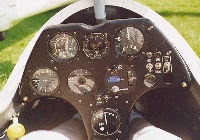
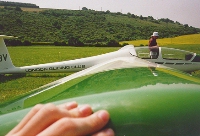
I was introduced to gliding in a 5-day course set up by my secondary school at the London Gliding Club, a small-ish airfield in Dunstable North of London.
|
|
|
|
|
|

|
When I went to Imperial College (Autumn 1994 - Summer 1995) I joined the Imperial College Gliding Club. They introduced me to Lasham Gliding Society, where they do their gliding. This is South West of London for those who are bad at geography. :-) |
|
Since I left Imperial College I have become a member of Lasham itself, and continued to glide, with the aim of becoming solo one day.

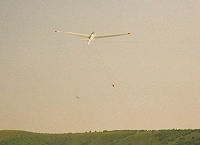
In order to become solo you have to be able to fly the glider for starters. It all begins with handling the glider on the ground, and getting the feel for the controls in the air - the stick and rudder. Basic skills are learnt, including various fundamentals such as lookout, turning, stalling, and more. Then you move on to winch launching and eventually landing. In addition you need to learn how to plan a circuit - what you do when coming in to land, how a spin occurs and how to recover from it, winch cable breaks - what do you do, and so on. Once you complete all the requirements to solo standard, you can look forward to becoming solo. The rules of the air are also required knowledge before you go solo, at least in Great Britain. This is the equivalent of the highway code on the roads.

I finally went solo on 25th June 1996! From here on, gliding is completely different, the equivalent of having passed a driving test. Now I get to decide myself where I want to fly (though still only nearby the airfield), and so on. My first flight of the day still has to be with an instructor, though (called a check flight, to check I'm still OK to fly solo).
I have to mention the way the instructor I had sent me solo. I thought we were about to have another normal flight. The instructor was fiddling about in the back. Suddenly, once the glider was at the front of the queue, without warning, instead of getting in he slammed the canopy shut on me and said 'away you go'. I was all nerves, but once I was up in the air, I was on cloud 9. What the instructor was actually doing in the back was putting all the straps together so that they aren't loose. You have to do this when flying solo in a two seater.
After becoming solo there are several colour cards to aim for. First comes white, then red, yellow and blue. Each is harder and more advanced than the previous. Note that these colour cards are Lasham's internal system. Externally there are the Bronze, Silver, and other badges (see below) that go alongside these cards.

The white card involves building on the solo requirements by revising things like stalls, spins, what to do when running out of height, problem circuits and judgement, cable breaks on winch, crosswind landings, strong wind flying, and so on. 15 solos are also required, and being able to perform a D.I. (Daily inspection) on the K13 two seaters and K8 single seaters, and a few more bits and bobs.
I got the white card on 27th September 1996, after the best month ever for me as far as gliding is concerned. I also flew a single seater glider for the first time on this day.

The red card builds on the white card with more full spin revision, going solo with aerotow launches, more winch training, strong wind flying, driving and refuelling the vehicle that tows the winch cables and the buggies that tow the gliders. The Bronze 'C' badge is also part of the red card requirements.
The Bronze 'C' requires 50 solo flights, two of which are soaring flights of half an hour or more off the winch (one hour off aerotow). Six of the solos must be in single seaters on three different days. Also required is a demonstration of 'landing out' in a motor glider. This is landing in a field, in preparation for cross-country flying, when this situation might happen. Finally, there is a flying test and written test (much like a British driving test).
The red card was updated in summer 1997 to include cross country endorsement. This was on the yellow card. Because I completed the red card under the old system, I completed the cross country endorsement separately. Since this is external to Lasham, this is not a problem.
Cross country endorsement consists of the following:
- Two soaring flights of 1 hour or more.
- One of them must be at least 2 hours.
- The endorsement must be completed within 12 months of the second of these flights.
- Field selection - You have to be able to demonstrate that you can select a field for...
- Field landings - A minimum of 2 successful approaches to fields be made. This can done in a motor glider.
- Navigation - you have to be able to demonstrate ability to navigate. You need to plan a 100km task (i.e. cross country flight).
On completion, cross country flights can finally be flown. Further training for cross country flights occurs on the Yellow card - see below.
I completed the red card and Bronze Badge on 18th August 1997, and the cross country endorsement on 6th July 1999 after a long run because of bad weather.

The yellow card was updated in summer 1997. Cross country endorsement was moved from here to the red card. See notes above...
The yellow card looks like this:
- Hangar landings - involves a longer than normal final approach.
- No brake approaches and landings
- Strong winds (Yellow sock - 20-something knots +)
- Dual cross-country
- Cloud selection and route selection
- Inter-thermal speeds
- 100 solo flights or 30 hours P1 (solo)
- 5 hour duration flight (with barograph)
- Silver distance (see Silver badge)
- Silver height (see Silver badge)
- Authorised to fly:
- Grob II
- DG 101/300
- Discus
- Use of gliding frequencies
- Yellow card flying test
As you can see, to complete the yellow card cross country flights are required. Finally, the confines of the area local to the airfield are left behind (on a good day!), and new areas await.
As you can see from the yellow card, the Silver 'C' badge is included within it. This consists of 3 legs - duration (5 hour flight), distance (cross country 50 km) and height (1000 metres I think...).
The yellow card flying test consolidates all the previous training, testing your flying to a higher standard than previous tests.
I completed the yellow card on 26th May 2003 by passing the Yellow Card flying test. I had left this a long time because I had been concentrating on solo and (when possible) small cross country flights. On 25th May though the weather was good but I failed to get a glider in the ballot. This made a good day to finally finish the card off.

From now on all the training concentrates on cross country flying, and looks like this:
- Task Planning & Selection - How good are you at planning a cross country flight given the day's conditions?
- Field Landing Revision in Motor Glider - Has to be done between June and August when the conditions are most defficult.
- Current Airspace Restrictions
- BGA 100Km Diploma (Part 1) - completion of pre-declared 100km task.
- BGA 100Km Diploma (Part 2) - completion of pre-declared 100km task at handicapped speed in excess of 65kph.
The blue card is the final card. After this the challenge is to complete longer and more demanding tasks as you get more experience.
Badge-wise, beyond the silver badge, the Gold and Diamond (very advanced) badges have increasingly demanding goals to complete. For the gold badge I need to fly a 300km cross country task and a height gain of 3000 metres (about 10,000 feet). I already have gold duration as that is the same as silver duration. For Diamond I need to fly a 500km cross country task and a height gain of 5000 metres (about 16,000 feet). The diamond goal is the same as the gold distance (but the turning points don't have to be in order).
I completed the 100Km Diploma (both parts) in one flight on 16/06/2003. I flew LAS-BI2-DID-LAS at a handicapped speed of 72.85kph in a Discus B.
In addition I completed my first 300Km flight on 30/08/2003. I flew LAS-TUR-BEM-LAS at a speed of 70kph in a Discus B. The most remarkable bit of this flight was that BEMbridge is on the Isle of Wight! So I had to cross over the sea to get there and back. This flight qualified for both gold distance and diamond goal.
On 05/10/2004 I also bagged gold height by climbing to 18,400 feet above Aboyne airfield. The height gain was 14,741 feet - well above the minimum for gold height and not far short of diamond height. This flight also completed my gold badge.
On 23 - 31/07/2005 I entered my first competition - the 2005 Lasham Regionals. The weather was pants, and I visited 2 farmer's fields, but I did come 2nd on one day, and got awarded the Best Newcomer shield. I am quite likely to have another go next year.
On 07/08/2005 I completed my first 500Km flight to complete diamond distance. I flew LAS-GRA-GRW-BIR-LAS at a speed of 77kph in a DG 300. The first leg upwind was slow and Grantham was a helluva long way from home, but after that with stonking conditions and the wind behind me, I had a superb run and completed the flight after about 6 and a half hours, with still an hour or so of soaring left in the day after I landed.
On 24/12/2005 I went up in the Superfalke with Gordon to do some instrument training. Since then I have been able to cloud climb in the gliders that have the correct instruments for this. My best cloud climb so far was to 10,500 feet above Lasham, near Andover in a Ventus C.
On 19 - 27/08/2006 I entered the 2006 Lasham Regionals. The weather was much better this time (not difficult), and this time made it home on all 5 task days. As a result I came 6th overall, which was well above my top 15 target, so I was very pleased with that.
On 11/10/2007 I finally got my diamond height. From Aboyne airfield in Aberdeenshire I took a Discus into wave all the way to the airspace limit at 24,000 feet. (My initial climb was straight from 2900 to 22,300 feet.) This flight completed my diamond badge.

In the future there are various ways I can go with gliding. Here are some of the things I could do:
If I think of any more then I'll add to the list.